
Top "Wrapped" Personalized Emails in 2025 and How to Prepare for 2026
Spotify, Strava, Monzo, and Duolingo all sent standout wrapped-style campaigns in 2025. Here's what made them work, and a practical roadmap for building your own before December 2026.
 First Publish Date:
 Every December, millions of users eagerly await an email. Not from a friend or a relative – but a marketing email. They screenshot it. They share it on social media. And they compare results with their closest circle. We are, of course, talking about Spotify's annual Wrapped campaign; a viral phenomenon which has spawned an entirely new genre of email personalization.
The "wrapped" email is a data-rich, hyper-personalized summary of a user's activity over the past year. And it's become one of the most anticipated and effective marketing tactics in existence today. But wrapped-style emails are no longer exclusive to streaming giants – banking firms, language learning apps, and fitness platforms have all joined the party, each putting their own spin on the format.
Let's break down the best wrapped-style campaigns of 2025, analyze what makes them work, and give you a practical roadmap to create your own year-in-review campaign for 2026.
Key Takeaways
- Wrapped-style emails generate exceptional engagement
- The best wrapped campaigns combine multiple personalization tactics: behavioral data (what users did), comparative data (how they rank against others), and turning stats into stories
- Spotify's Wrapped remains the gold standard, but 2025 saw exceptional entries from Monzo, Duolingo, and Strava, too
- Successful wrapped emails share five key elements: personalization at scale, shareability, surprise, timing, and a clear narrative
- Preparing for 2026 means auditing your data collection now – you can't create a year-in-review email without a year's worth of data
What is a "Wrapped" Email?
A wrapped email is like a Spotify Wrapped for brands – a year-in-review summary that takes each users' own behavioral data to create a highly personalized, playful, and deeply shareable recap of their activity over the past year.
The name comes from Spotify's "Wrapped" campaign, which has run annually since 2016 and has become one of the cultural cornerstones of the 21st century.
The best wrapped emails do the following 5 things:
1. Hyper-personalization at scale
Every user receives a completely different email. Not just different name fields, but entirely different statistics, graphics, and narratives based on their unique behavior.
2. Shareability
Wrapped emails are designed to be screenshotted and shared on social media. They're visually distinctive, easy to read at a glance, and often include elements of pride or humor that users want to show off.
3. Surprise and delight
The best wrapped emails reveal things users didn't know about themselves. A surprising statistic, an unexpected pattern, or a playful observation that makes the user smile.
4. Perfect timing
Wrapped emails arrive in early December, before the holiday chaos fully descends, giving users time to engage and share. They're a celebration of the year that was, not a promotion for what's coming next.
5. A clear narrative arc
Rather than dumping raw statistics, wrapped emails tell a story. They take the user on a journey from "here's where you started" to "here's what you achieved" to "here's how you compare."
Let's look at the biggest brands that nailed these elements in 2025.
Spotify Wrapped: The Original and Still the Best
Spotify launched Wrapped in 2016, and ten years later it remains the gold standard. In 2025, Spotify continued to refine its formula while introducing new features that kept the campaign fresh.
What makes it work?
Spotify Wrapped is a masterclass in turning data into narrative. The 2025 campaign included each user's top artists, top songs, total listening minutes, and much more besides.
Spotify understands that people don't just listen to music – they use music to define their identity.
Wrapped isn't really about data… It's about validation. When Spotify says you're in the top 1% of Bluey and Blippi listeners, it's a badge of honor. You have kids' music on repeat – you're a great parent, and other parents can relate to this, too.
And when you're in the top 1% of Taylor Swift listeners, you're a true Swiftie.
But it could be Mötorhead, Vivaldi, Linkin Park or Tom Lehrer – it doesn't matter. If you're the top listener of something you connect with deeply, you're going to take interest in that stat.
This emotional hook and personal validation drives social shares through the roof [1].
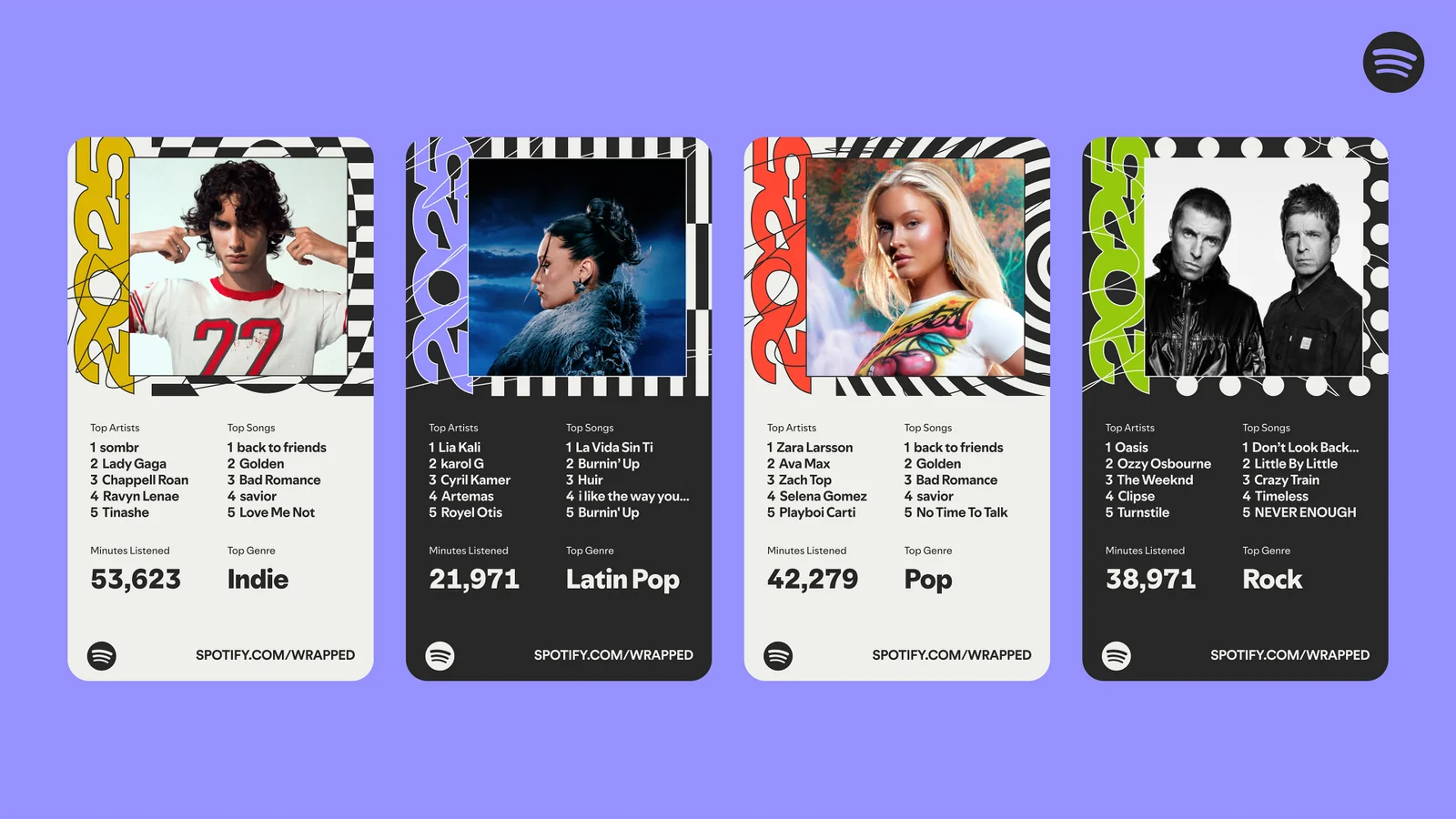
Spotify Wrapped is designed for social sharing from the ground up. The bold, colorful graphics look great on Instagram. The stats are easy to screenshot, and can be shared directly from the app. And there's always an element of friendly competition – comparing your top artists with friends is part of the fun!
What you can learn from Spotify Wrapped
Spotify's genius is making each user feel like the hero of their own story. The data is the set dressing, not the main event. When creating your wrapped email, ask yourself: what does this data say about who my customer is, not just what they did?
You can read more about Spotify's approach to the campaign on their newsroom page [2].
Strava: The Year in Sport That Celebrates Every Athlete
Strava's annual "Year in Sport" campaign is genuinely different from the Spotify Wrapped approach. Rather than simply serving up a list of stats, Strava combines deeply personal activity data with broader community insights, to create a product that's both personal and social.
What makes it work?
Strava's Year in Sport campaign gives each athlete their own set of statistics: total distance covered, total elevation gained, total hours spent moving, number of activities logged, personal bests achieved, and favorite routes discovered. For a dedicated runner who's tracked every training session, this data is deeply meaningful.
But Strava adds something extra: a global trend report that aggregates anonymized data from its entire community. This data reveals broader patterns in how people exercise, what motivates them, and what barriers they face.
Strava users are social – following friends, joining clubs, giving kudos, and comparing times on segments. The Year in Sport campaign shows users how they stack up against their own network, and encourages sharing among the most competitive.
But perhaps more importantly, Strava celebrates effort. A user who logged their first ever run gets as much celebration as a user who completed an ultramarathon. This inclusivity expands the campaign's appeal enormously, and prevents an "Us vs Them" situation.
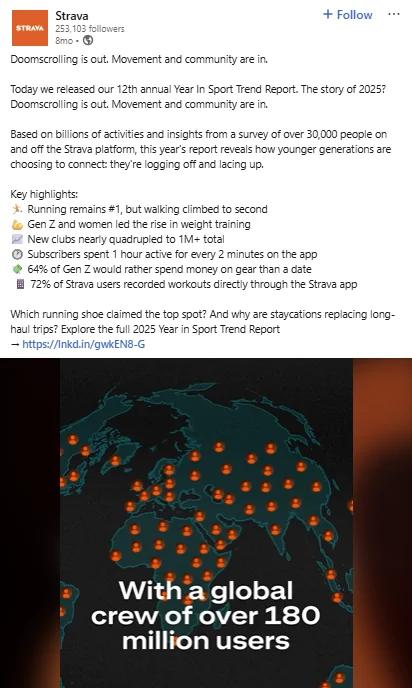
View the original post on LinkedIn.
Strava's Year in Sport includes an eye-catching branded summary graphic that users can share on social media. It features their total activities, total distance, total time, and a distinctive visual in Strava's style.
What you can learn from Strava
Strava proves that personal data becomes more valuable in a community context. Your users don't exist in a vacuum, and they want to know how they compare to others. People want to feel part of something larger than themselves – so if you can add a community layer to your wrapped campaign, even a simple line like "You were one of 500 customers who bought [rare product] this year", you'll transform a personal email into a shared experience.
Monzo: The Bank That Made Spending Fun
Monzo, the UK digital bank, has quietly built one of the most effective wrapped-style campaigns outside of music. Its annual "Year in Monzo" email transforms mundane banking data into a colorful, engaging, and genuinely useful summary.
What makes it work?
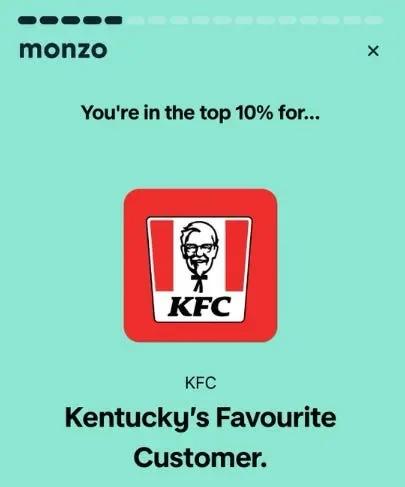
Year in Monzo breaks down spending into playful categories, and avoids being too personal or financially revealing. It'll identify your favorite fast food joint, your quirkiest habits, and show you what you actually spend your money on – in a fun, engaging, and highly sharable way.
This really works because money is often a source of anxiety. Monzo's take on the wrapped personalized email craze reframes spending as a positive thing, giving users a unique financial personality.
Monzo's wrapped emails are genuinely funny and relatable, and that's why users share screenshots of their "Coffee Connoisseur" status or some surprising spending category they're at the top of.
What you can learn from Monzo
Even "boring" industries like banking have interesting data. Monzo proves that no matter what you do, your users' behavior is inherently interesting to them.
Revolut: Global Spending, Personalized
Revolut, the global financial app, is a major outlier in this list – but we included it because it gives us an important lesson to learn.
While all the other wrapped campaigns in this post are for 2025, Revolut has been absent from doing wrapped-style campaigns since 2023. That's because Revolut took a very different approach, which was a little more revealing than Monzo's, and prompted some backlash [3].

They were likely joking around and trying to be hip, but there were some accusations of privacy being breached and users feeling patronized. Playful banter or a misguided misfire? Either way, the combination of financial overexposure and mockery made most users feel less willing to share their RevReviews publicly.
What you can learn from RevReview
Different users value different metrics. Revolut pushed for provocation (not just in this campaign, but in others, too [4]) and ended up isolating itself. You can go too far with personalization, especially when it's intended to be shared publicly!
Duolingo: Gamified Learning, Delightfully Presented
Duolingo, the language learning app, has a natural advantage when it comes to wrapped-style emails. Learning a language is a long-term achievement, and users are genuinely proud of their progress – but they're also putting a ton of data through the platform.
Duolingo's wrapped campaigns started with wrapped personalized emails in 2019, but have since grown into a major app-based experience [5].
What makes it work?
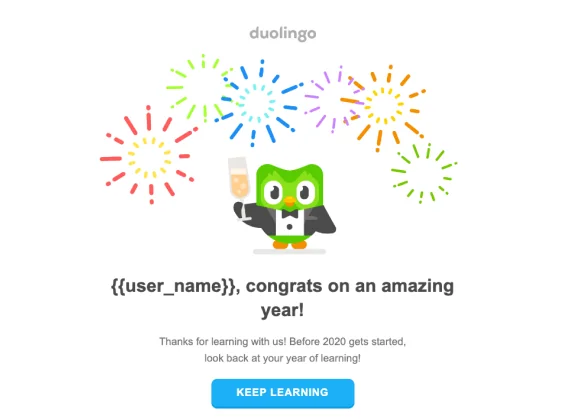
In 2025, Duolingo's wrapped campaign included stats like total minutes learned, languages studied, longest streak, and number of lessons completed [5]. The achievements are presented by Duo, the distinctive green (and sometimes a little mean!) owl mascot, in a bunch of fun animations. The copy is light and playful, and leans into the old Duolingo memes that made the app a viral hit in the first place.
Learning a new language is hard work, and Duolingo's wrapped email validates the effort. It can be deeply emotional and meaningful to have that acknowledged. It also gives users a chance to show off their progress and knowledge, and helps them encourage friends to join.
What you can learn from Duolingo
If your product involves any kind of long-term progress (learning, fitness, productivity, saving), a wrapped email is a great fit. Your users have achieved things they're proud of, so help them celebrate.
How to Prepare for 2026: A Practical Roadmap
Creating a wrapped-style email isn't something you can do in December – you need to start preparing now. Here's your roadmap for getting a wrapped email out in time for end-of-year 2026.
Start Auditing Your Data
A wrapped email is only as good as the data behind it. If you're not already tracking the metrics you want to highlight, you won't have them in December. Review your current data collection now.
- What user behaviors are you tracking?
- What patterns would be interesting to surface?
- What metrics would your users genuinely care about?
Make a list of every user action that could become a statistic in your wrapped email, and check whether you're actually capturing that data. If you're not, set up the tracking now (you might have to hold off your wrapped campaign until next year).
Identify Your Narrative
The best wrapped emails tell a story. Before you design any graphics or sharing systems, decide what story you want to tell:
- Is it about achievement? "You accomplished this much"
- Is it about identity? "This is who you are as a user"
- Is it about surprise? "You won't believe what you did this year"
- Is it about community? "Here's how you compare to/helped others"
Or is it a combination of all of these? Whatever your narrative is, it will determine which metrics you emphasize and how you frame them.
Design for Shareability
Your wrapped email should be visually distinctive, easy to screenshot, and optimized for social media. That means bold colors, clear typography, and a layout that works when cropped to a square or vertical format.
Create personalized share cards within the email, so users have quick options when posting to different platforms.
Build Your Technical Pipeline
Generating millions of unique, personalized emails requires technical infrastructure. Each user needs their own set of statistics, their own graphics, and potentially their own narrative copy.
Sendtric lets you easily create personalized images for email campaigns, but you'll also need your ESP or internal systems to handle the data. Start testing your pipeline in October – not December!
Test Your Timing
Wrapped emails arrive in the first week of December [6], which gives users time to engage before the holidays. It also avoids competing with last-minute shopping campaigns and other communications.
But the right timing might vary for your audience. A B2B wrapped email might perform better in January, when professionals are back at work and reflecting on the year ahead. A consumer brand might want to catch the December social media surge, and push their wrapped email in late November.
Test different send dates with small segments to find your optimal timing for the years ahead.
Why Go Through All This Trouble?
A wrapped campaign requires data collection, personalization infrastructure, design resources, and careful planning. So why bother?
Because the results are genuinely extraordinary.
| 2024 | 2025 | Change |
|---|---|---|
| 200 million users reached in 62 hrs | 200 million users reached in 24 hrs | +61% |
| Approx. 354 million total reach | Approx. 500 million total reach | +41% |
Spotify's 2025 Wrapped campaign reached 200 million engaged users in approximately 24 hours – a 19% increase year-over-year [1]. In 2024, it took Wrapped around 62 hours to hit that same milestone. The campaign also drove around 500 million shares, a 41% increase from the previous year.
Smaller brands see similar disproportionate returns. EmailLove's experimental 2025 Wrapped email, sent to just 1,000 users, achieved a 57% open rate with zero unsubscribes or spam complaints [7]. For context, average email open rates are 36.92% in 2026 [8].
The reason wrapped campaigns perform so well comes down to psychology.
Behavior-triggered emails generate up to 10 times more revenue than generic sends [9]. When you combine that principle with the year-end reflective mindset – people naturally want to look back before they look forward – you create a perfect storm of engagement. Segmentation can boost open rates by 30% and click-through rates by 50% [9], and wrapped campaigns are segmentation at its most extreme: every user gets their own unique email.
There's also a cumulative brand benefit. A successful wrapped campaign crushes your KPIs for this year, and creates anticipation for next year. Users actively look forward to receiving their annual recap. They share it voluntarily. They compare results with friends. That kind of enthusiastic engagement is impossible to manufacture with any other type of marketing email.
So yes, wrapped campaigns take work. But the ROI is consistently among the highest in email marketing.
Ready to make your own personalized emails? See how to build your own wrapped email with Sendtric in minutes, or get started for free below.
Create Personalized Emails Easily, with Sendtric
Sendtric gives you the power to supercharge your email marketing. You get a suite of tools to deploy email personalization tactics, without complex coding or development resources.
With Sendtric, you can easily integrate personalized images that dynamically change based on subscriber data – or countdown timers that display the exact remaining time for a personalized offer. You can generate interactive polls, and weather widgets that pull real-time conditions for localized campaigns.
These widgets are designed to work seamlessly across all major email clients, across desktop, mobile, or tablet, integrating effortlessly with your email campaign platform. Best of all? They're all included in every pricing tier – even our free plan!
Try it now – create a free personalized email widget
Frequently Asked Questions
What is a wrapped-style email?
A wrapped email is a year-in-review summary that takes a user's own behavioral data to create a highly personalized recap of their activity. The term comes from Spotify's annual Wrapped campaign.
When should I send a wrapped email?
Most wrapped emails arrive in the first week of December. B2B brands may find January more effective.
What data do I need for a wrapped campaign?
You need a year's worth of behavioral data – what users did, how often they did it, and any relevant comparative metrics (rankings, percentages, trends).
Can small businesses create wrapped emails?
Absolutely. You don't need Spotify-scale data. A local coffee shop could send a wrapped email showing customers how many visits they made, their most-ordered drink, and a reward for their loyalty. The scale is smaller, but the impact is similar.
How do I make my wrapped email shareable?
Design for screenshots. Use bold, distinctive visuals. Keep statistics easy to read at a glance. Consider creating easy-to-use share cards within the email, and give users a clear reason to share – pride, humor, or friendly competition.
Sources
[2] https://newsroom.spotify.com/2025-12-03/2025-wrapped-user-experience/
[4] https://www.bbc.co.uk/news/business-47117649
[5] https://blog.duolingo.com/year-in-review-behind-the-scenes/
[6] https://en.wikipedia.org/wiki/Spotify_Wrapped
[7] https://emaillove.com/our-2025-wrapped-email