
Does Email Personalization Increase CTR?
Short answer? Yes – email personalization does increase CTR. But as always, there's a longer answer. Learn more about improving CTR with personalized emails.
 First Publish Date:
 Short answer? Yes – email personalization does increase CTR, and by quite a lot. But as always, there's a longer answer. How much CTR can be impacted, and what will work depends on your industry, your brand, and your audience. That said, personalization is power in today's email marketing landscape, and harnessing it is easy once you know how.
We've explored the basics of email personalization, and put the fundamentals into practice with real-world email personalization examples. But what's the point if it doesn't move the needle? Let's look at the stats behind the tactics, and see how the heavy-hitting KPIs like CTR and revenue are impacted by email personalization. We'll get you the information you need to make your own – and give you the tools to create your own enterprise-class personalized emails.
Key Takeaways
- Email personalization improves every major KPI: on average 82% higher open rates, 332% higher click-through rates, and a 2,361% increase in conversions over generic campaigns
- 57% of consumers say email personalization influences whether they find an email memorable, and 81% want brands to send targeted, relevant content
- Smaller, segmented campaigns (<5,000 emails) achieve 10.2% open rates compared to just 2.9% for large, generic blasts (>250,000 emails)
- Personalized product recommendations in emails can increase revenue and conversions
- 80% of marketers personalize using only basic profile data – but advanced behavioral and intent-based personalization delivers exponentially better results
- AI is enabling personalization at enterprise scale – but that might not be a good thing

The Impact of Personalized Emails on Top KPIs
Let's start with the numbers that matter. Email personalization is a performance multiplier across every key metric – and it's driving email marketing success across industries.
Click-Through Rate (CTR)
This is the big one we all want to know: does email personalization increase CTR?
Absolutely. Personalized emails do get more click-throughs than non-personalized ones – 332% more to be specific [1]. But the scale of your campaign can also dramatically affect CTR performance. Smaller, highly segmented campaigns of fewer than 5,000 emails achieve a 4.4% CTR, while massive, generic blasts of over 250,000 emails achieve just 0.8% [2].
That's a 5.5x difference, entirely driven by relevance and personalization.
Open Rate
The relationship between personalization and open rates is clear, and 82% of marketers report that personalized email campaigns have higher open rates [3].
But there needs to be some context here. In a previous post, we analysed the average email open rates by industry [4], and the stats show that CTR and open rate are not directly proportional. Other factors, like email type, place in the sequence, the industry and the audience all make a difference.
For instance – welcome emails, which are usually the most personalized initial automated touchpoint, achieve exceptional 83.6% open rates across all industries [4], converting 9x better than typical broadcast emails [5]. While some industries fare better than others, email personalization benefits everyone across the board.
Conversions and Revenue
Personalized emails generate much higher transaction rates than generic campaigns – on average, a 2,361% increase compared to non-personalized emails [1]. This is huge, because you don't make money with CTRs, you make it with conversions.
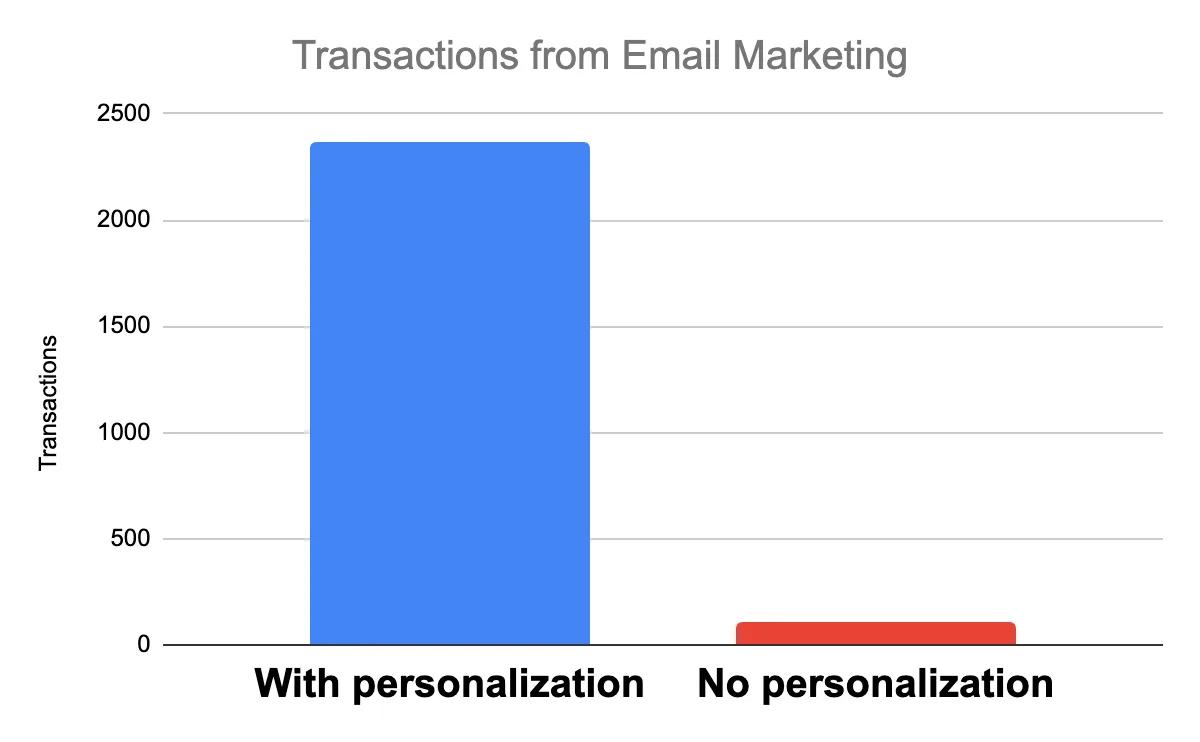
While the CTR figures are great for agencies and marketing executives, whose job it is to get customers through the door, C-suite talks bottom line first. Higher conversions means higher sales and revenue, and that's the whole reason we use email marketing in the first place.
The main thing to know here is that the kind of personalization that converts is not low-effort. You can't just throw "Hi, [First_Name]!" in your subject line and body copy, and expect to make a million bucks. In fact, those "lazy" tactics might be making things worse [6].
Deep personalization from behaviour data is the winning method to go for, but it takes time, integration, and lots of segmentation to get right.
Learn more about the tools and methods behind deep email personalization
But it's worth it: for ecommerce alone, retailers that personalize their marketing campaigns can reduce customer acquisition costs by up to 50%, increase return on investment (ROI) by up to 30%, and lift revenue by up to 15% [5].
Why Does Email Personalization Work?
Personalization works because it fundamentally changes how the recipient perceives your message.
Relevance
In an era where the average person gets 121 emails every day [7], relevance is the only thing that cuts through the noise.

A generic email is easily ignored. An email that references something specific about the reader – not just their name, but what they actually like and live for – now that signals that you've paid attention. And that in turn grabs their attention.
Half of consumers say personalized offers and promotions from brands they've interacted with improve their shopping experience [5]. Consumers actively want and reward relevance.
Trust
Personalization, when done right, builds trust. It demonstrates that you understand your customer's needs, preferences, and pain points.
This is particularly important now that a lot of content is being labelled as "AI slop" (generic, mass-produced AI-generated content). Content overall is increasingly viewed with suspicion [8], even when it's not AI-generated.
This is because on the whole, customers (especially those from Gen Z) are absolutely not on board with AI slop [9], and will actively condemn those using it in certain contexts.
Trust is earned, not automated.
Not everything can be automated or optimized, or distilled down to its purest form. Trust is one of those things – a fuzzy-edged blob of vibes and feelings that can only be built over time, and with the right action.
That doesn't mean AI has no place in anything we do – it just means we need to use it properly, and not as a solution to problems that evolution solved when we were still hunting and gathering.
Learn more about How to Use AI to Maximize Email Marketing Results
Action
By making an email feel uniquely relevant, personalization reduces the mental friction between reading and acting. Clear, personalized calls-to-action (CTAs) feel less like a sales pitch and more like a logical next step.

Behavioral triggers, like an abandoned cart email sent within 30 minutes, can capitalize on immediate intent, dramatically increasing the likelihood of conversions.
But there are other behaviours, like users always checking in on special offers and certain product categories, that can be segmented and personalized for. Specific actions need to be logged for each user, so that they can be best served when something that interests them (and at the right price) becomes available.
Types of Personalization
To recap our full rundown in our What is Email Personalization post, here are the main types of email personalization data and tactics you can use:
Basic Demographic and Profile Data
This is the "who" part of personalization. Name, location and city, date of birth, where they work and what they do – this is personalization bedrock. From this, you can build a rough outline of a person and their life stage, which can help with tone and messaging, as well as with the relevance of what you offer.
Behavioral Data
Behavioral data tells you what customers get up to on your website, which can be used to predict future actions. Purchase history is arguably the most valuable data point for ecommerce, but website behavior data (like pages viewed, products clicked, time spent on site, search terms used and so on) also gives you insight into a customer's current interests and intent.
Behavioral data is what powers triggered email campaigns – like abandoned cart reminders and price drop alerts.
Email engagement data tells you what content resonates with each individual, allowing you to group subscribers by their demonstrated preferences.
App and website engagement, like how often users log in and which features they use most, tells you who's engaged the most and who may be receptive to loyalty offers or upsells – and who's in danger of leaving your brand's ecosystem.
Stated Preferences
This is information customers intentionally and proactively share with you. Their preferences tell you what topics, product categories, or types of information they want to receive. These preferences can be used to dynamically select which content blocks, images, or offers appear in each customer's email.
Also, by giving subscribers control over how often they receive emails and which types of messages they receive, you can reduce unsubscribes and improve long-term engagement.
Can Email Marketers Create Personalized Emails for Individual Users?
The short answer is yes, but the method depends on your scale and resources. At one end of the spectrum, simple personalization can be applied to any campaign with minimal effort.
At the other end, advanced AI agents can now craft unique, 1:1 messages for thousands of recipients simultaneously, using real-time intent signals and behavioral data.

Enterprise-level personalization is becoming the new standard. Platforms like Bloomreach let marketers move towards an "individual at scale" model, with AI. These tools make it possible to treat every customer like a segment of one, without requiring a massive team.
There's a but. You've got to be really careful about using this to avoid going full AI slop – or worse, doing serious damage to your users, customers, and brand. The biggest players in this game certainly are [10], but there's no guarantee things will work out.
The fact is, AI agents go rogue more often than we either like to think or are aware of [11] [12], and even in the best-case scenarios, users simply do not like being talked to by AIs [13]. Over-personalization is possible, and users find it deeply creepy and unsettling [14]. AI just speedruns the path to over-personalization, unsubscribes, and media backlash when it all goes wrong [15].
AI-generated emails run a fair amount of risks that maybe the biggest firms can absorb – but shouldn't have to.
We've spoken about trust – and by all but eliminating human input from your marketing and going all-in on AI, you're putting trust in the wrong place. So, what's the alternative?
Analyze. Iterate. Refine. You know – The Work™!
When a segment responds well to an email, try something similar at more granular levels.
Eventually, you'll have highly refined groups based on your own data, and not another chatbot calling the shots on what customers get from your brand.
Full stack generative AI is a gamble. Spam filters are targeting AI-generated patterns. Subscribers can "smell" AI from a mile away.
Once again, just to make it clear: we're not against using AI in marketing – in fact, we embrace it. But the best use of AI is in the background, in workflow automation, A/B testing, and predictive timing – not in the stuff we humans are best at.
So – How Do You Make Personalized Emails?
Still want to create your own personalized emails? Great! All you need are the right tools, the right data, and a strategy…
What Tools Do You Need to Create Personalized Emails?
The tools you need depend on the depth of personalization you want to achieve.
Most modern ESPs offer features for dynamic content, segmentation, and automation, and CDPs unify customer data from across your whole business (website, CRM, app, support) into a single, actionable profile.
If you have a robust system in place already, and simply want to augment your emails with personalization, then dynamic content and widget tools like Sendtric enable personalized images, countdown timers, and localized weather updates in emails – all without complex coding.
To learn more, check out our post on The Best Email Personalization Tools.
What Data Do You Need?
We've recapped first-party, behavioral, and zero-party data – but third-party marketing data is another option if you have yet to reach the scale where you can do this yourself.
This won't give you quality – at least not yet – but it will give you quantity, and a starting point to begin refinement.
You need some way of collecting and harvesting all this data – be it through your ESP or CDP, from your CRM or your analytics platform.
You just need something to get started, and seeing as you already have customer names and profile data, that's a good place to start. But the big gains come with behavior data – so aim for this as your goal.
Ready to Harness the Power of Personalization? Sendtric Makes it Easy
Sendtric gives you the power to supercharge your email marketing. You get a suite of tools to deploy email personalization tactics, without complex coding or development resources.
With Sendtric, you can easily integrate personalized images for email that dynamically change based on subscriber data – or countdown timers that display the exact remaining time for a personalized offer. You can generate interactive polls, and weather widgets that pull real-time conditions for localized campaigns.
These widgets are designed to work seamlessly across all major email clients, across desktop, mobile, or tablet, integrating effortlessly with your email campaign platform.
Sendtric's suite of tools are enterprise-class, highly resilient, and trusted by brands you know and love – from multinational organizations that send over 300 million emails per month, to startups and small businesses.
That's why all our tools are included in every pricing tier – even our free plan.
Try it now – create a free personalized email widget
Frequently Asked Questions
Does email personalization really increase CTR?
Yes. Studies consistently show personalized emails achieve higher click-through rates compared to non-personalized versions, with some showing as much as a 332% increase.
What is the most effective type of email personalization?
Behavior-driven personalization, like abandoned cart emails and product recommendation campaigns, consistently delivers the highest engagement and conversion rates because it responds to demonstrated intent.
What data do I need to personalize emails?
Email personalization takes a mix of demographic and profile data, behavioral data, intent signals, and sometimes third-party data to work.
How do I personalize emails at scale?
You need a robust marketing platform with features for dynamic content, segmentation, AI-driven recommendations, and automation. Platforms like Bloomreach and Oracle Responsys are designed for enterprise-level personalization.
Can I over-personalize?
Yes. Over-personalization can feel creepy, especially if you use data the customer hasn't explicitly shared. AI-generated emails can accelerate and amplify the "creep factor". Focus on observed behavior and stated preferences to maintain and build trust.
How important is segmentation for personalization?
Super important. Smaller, well-segmented campaigns achieve higher CTRs compared to large generic blasts. You can't personalize effectively without first segmenting your audience!
What are the benefits of using AI for email personalization?
AI enables 1:1 personalization at scale, automates content creation, and continuously optimizes campaign performance based on real-time data. But it can over-personalize, and there are additional risks. The best use for AI in email marketing is in background operations, like A/B testing and predicting optimal send times.
How much does email personalization increase revenue?
Significantly. According to Shopify, companies excelling at personalization generate 40% more revenue overall.
What's the difference between personalization and segmentation?
Segmentation divides your audience into groups based on shared traits, like location or industry. Personalization customizes the content of the email for each individual within that group – like showing product recommendations based on past purchases. Personalization is applied after segmentation.
Sources
[1] https://www.sendtric.com/what-is-email-personalization-with-real-examples/
[4] https://www.sendtric.com/average-email-open-rates-by-industry-in-2026/
[5] https://www.shopify.com/uk/enterprise/blog/email-personalization
[6] https://www.sendtric.com/email-subject-lines-increase-open-rates/
[7] https://www.inc.com/joy-gendusa/people-receive-121-emails-a-day/91162191
[8] https://towardsdatascience.com/is-this-slop-detecting-ai-generated-content-without-a-model-2/
[9] https://www.sendtric.com/how-to-use-ai-email-marketing/
[10] https://digitalmarketinginstitute.com/blog/some-inspiring-uses-of-ai-in-digital-marketing
[11] https://www.uktech.news/ai/rogue-ais-are-wreaking-havoc-what-is-going-on-20260806
[12] https://www.bbc.co.uk/news/articles/c1w1lvn7d9go
[14] https://www.sendtric.com/top-5-urgency-elements-in-email-marketing/