


While we were researching this piece on the state of AI in email marketing in 2026, we found some rightful skeptics. And a lot of “AI slop”. It seems we’re at peak AI, and a lot of social media-savvy consumers are over it. But where does AI excel? Is it automation, prediction – or something else? Let’s find out… By the end of this post, we hope you’ll have a clearer view – so you can deploy AI in a way that maintains trust, reduces noise, and drives measurable results.
Key Takeaways
- Trust can’t be automated. Consumers are skeptical of AI, especially Gen Z [1]
- Full stack generative AI is a gamble. Always edit, verify, and humanize everything
- Spam filters are targeting AI-generated patterns. Reliance on AI eats deliverability
- Subscribers can “smell” AI. Off-brand tone and generic imagery trigger unsubscribes
- AI slop (low-quality, mass-generated text and images) is facing massive audience pushback. Human genesis and final sign-off are the bare essentials
- The best use of AI is in the background: workflow automation, A/B testing, and predictive timing
- Small, well-timed emails outperform massive blasts. Two percent of sends can generate 50% of revenue when powered by real intent signals [2]
Generation Skeptic: The Audience Cares

Let’s start things off with how not to use AI in email marketing, because it really feels like most marketers have got this all backwards right now. If you’re just adding to the noise and ignoring the stuff that actually works, AI can completely kill your brand.
All you need to do is the same thing we’ve always done: serve the audience. But it looks like we’ve got our expectations of our audiences backwards, too.
Technology adoption usually splits demographics up into well-defined age groups. For example, back in the early days of smartphones, millennials were the first to adopt and adapt, while Gen X and Baby Boomers were further behind the curve.
Today, AI is “the new thing” – and unlike previous “new things”, its use is dispersed pretty evenly throughout all age ranges. That’s weird in and of itself, but what’s even weirder is how different age ranges are reacting to it.
Older generations tend to be more skeptical of new technology and slower to embrace it, but with AI, younger audiences have taken up the role of generation skeptic. Gen Z in particular have developed a sharp dislike of artificially generated content. Raised on a diet of deepfakes, bot-driven social media, and algorithmically curated feeds, Gen Z is the most resistant group to AI today [1].
This matters enormously for email marketers because Gen Z is a core spending group, with high digital literacy and low tolerance for inauthenticity.
When they suspect an email was created entirely by AI, they don’t just delete it – they go full scorched Earth. They unsubscribe, mark as spam, and share screenshots of “bad AI” on social platforms. They’ll put effort into it, because the marketer didn’t.
Skepticism isn’t just limited to the young. Across all age groups, consumers are growing tired of content that feels generic, repetitive, and soulless – what’s been dubbed “AI slop”. And you should care, because your audience cares.
Trust is the foundation of the inbox relationship, and once a subscriber believes your brand is automating that relationship away, the connection is all but gone [1].
Generative AI is a Gamble
The idea of a magic button that does everything in your email pipeline is so exciting to marketers and leadership. Instant copy, perfect subject lines, beautiful images, and flawless HTML – all generated in seconds? It’s the dream!
But sadly, reality doesn’t match that dream.
The risk of adding to the AI slop pile is one thing, but rickety code, compromised security, hallucinated discount offers [5], and handing over autonomy could be absolutely disastrous for brands.
Sender AI and Inbox AI
In 2026, AI exists on both sides of the email equation. Marketers use AI to generate content, subject lines, and optimize send times. On the other side of the fence, email providers and spam filters use AI to detect patterns, flag anomalies, and decide what lands in the primary inbox.
These two AIs are not neutral toward one another.
Inbox AI is increasingly trained to recognize and deprioritize content that exhibits signs of generative AI: predictable sentence structures, overused transition phrases, a lack of specific, verifiable detail, em dashes, and “it’s not just X, it’s Y!” [2] – the usual hallmarks of AI copy.
Marketers who ask AI to do everything from strategy to copy, and from design to sending, will inevitably produce emails that can get caught in spam filters. As content becomes homogenous, predictable, and separated from our cultural reality, brand endangerment is a real possibility.
Your brand voice is an asset. Generative AI, trained on the whole darned internet, defaults to the average of everything it has seen.
If you mix all the colors up on a palette, you get beige. And AI is the beigest.
It’s not distinctive. It’s not memorable. It is, by definition, average.
When you let AI write and add images to your emails, you’ve surrendered your brand to something that doesn’t care about it [4]. Your team, your go-to experts – these are the ones you need to trust with your brand. Not AI.
Hallucinations, False Information, and Rickety Code
Every new model is claimed to be the singularity – the birth of artificial life, the AI that will finally take all our jobs, destroy all humans, and turn the world into a pile of paperclips. But for all the hype, we’re not even at the “hands off” stage yet. Not even close.
Generative AI is famously prone to hallucinations, confidently stating false information as fact [7]. In an email context, a hallucination might be a product or price that doesn’t exist [5], a made up shipping date, or a customer service promise that your team can’t fulfill.
AI-generated HTML and email code remain notoriously unreliable. Email clients (Gmail, Outlook, Apple Mail) each render code differently. AI models are not consistently trained on these rendering quirks, resulting in broken layouts, missing images, and CTAs that don’t click. A broken email is worse than no email at all – especially if it’s something the user really wanted!
Noise vs. Value
Email marketing has always struggled with a tension between valuable, relevant, timely communication, and noise.
Generative AI makes it trivially easy to produce more noise, faster, and the backlash against AI slop is massive. Audiences don’t care what an AI thinks about a product – they want to know what people think. They want to see what people create.
Sure, AI can be helpful in prototyping or mocking up layouts, but the work must be human, the message must be human. And the final sign-off has to go through someone who cares. Emails that skip it all to speed up the process are consistently punished with low engagement and higher unsubscribe rates [2]. This is all to say, AI without strategy is just more noise, faster.
Subscribers can “smell” AI. And they don’t want it.
This is despite all the data you’re getting, telling you to act on user behaviors. “User X scrolled 33% through the email”, “23.3% of users clicked CTA 2”, “unsubscribes are highest on a Tuesday” – automating content based on weird metrics is only going to average things out further, and risks flooding inboxes based on behaviors that simply don’t mean anything.
In a roundtable discussion on How to use AI for your email campaigns in 2026 [6], one of the experts on the panel (Beth O’Malley from Astral) puts it perfectly:
“If people don’t have guardrails and a real good understanding of what should be sent as an email and what shouldn’t, we’re going to end up in the same spot we are now – which is too many emails for too many signals. And we’re going to end up punishing ourselves because we’ve tried to solve this problem, but now we’ve filled people’s inboxes based on all of this data. That could easily become a problem.”
Automation and Backend Tasks
Okay – so that’s the finger wagging out of the way. We all know how not to use AI in email marketing. So, if we shouldn’t be using it for copy, images, and code, what should we be doing instead?
Automation.
This is absolutely the best use case for AI in email marketing. We’re talking workflow optimization, A/B testing, hyper-personalization, and perfect timing of email delivery. All the stuff you want to do, but either don’t have the resources or the knowledge to pull off.
Forget generative AI. Automation and optimization are everything.
Workflow Optimization and A/B Testing
AI excels at the “boring” jobs that consume marketing time. Setting up complex workflows, dynamically inserting content blocks based on subscriber behavior, and automatically rotating through A/B test variants are all tasks AI can handle reliably – unlike creative processes and deep research.
For A/B testing specifically, AI can go far beyond typical “Subject Line A vs. Subject Line B” tests. AI-powered testing can continuously optimize send times, content order, image selection, and CTA placement across dozens of variants simultaneously – then automatically allocate more send volume to winning combinations [8].
Hyper-personalization
Hyper-personalization is a killer AI use case, but it can be uncanny and creepy if you go too far. It all depends on whether you personalize based on stated preferences and observed user behavior, or from third-party sources and “snooping”.
Hyper-personalization can be super helpful if you get to know users’ downtime (when they’ll be checking email), their buying schedules, their triggers for purchase, their history, and their likes and dislikes. It’s a fast-track to personalizing imagery in their inbox, maximizing send times, and making them feel like your communications are tailored to them.
Using Your First-party Data
Taking this a step further, AI can scan your CRM and ecommerce platform to find personalization opportunities a human would miss. For example, an AI might identify that a customer buys a specific coffee blend every three weeks, then trigger a replenishment reminder on day 18. That’s helpful. That same AI, if left unchecked, might also note that the customer lives in an affluent zip code, and dynamically increase prices. That’s predatory.
The key is, don’t give the machine executive control. Let it tell you what’s going on – make it a supercharged assistant that can scan your entire data set and give you actionable guidance on what to do next.
Predictive AI: Timing Emails at the Perfect Moment
One of the most powerful, least-hyped applications of AI in email marketing is predictive timing.
When you send an email matters as much as what you send. Sending the right message at the wrong time is almost as useless as sending the wrong message – and this is a clear area of disruption for email.
Mass sending and hoping it works is so archaic, but we’re still firmly in that era. To think it’s taken this long for email to evolve beyond it is actually kind of amazing, but AI finally gives us a way out of “send and hope”.
Industry data consistently shows a stunning concentration of value in timely, intent-driven emails.
Expert marketing veteran Larry Kim explains:
“If there’s a signal where you know that someone did something, and you send it within 30 minutes – those emails could represent 2% of the total [sent emails] for a brand, but generate 50% of the revenue. On the B2B side, they’ve also figured this out. It’s not necessary to send an email to every VP of marketing. What matters are these intent signals.” [6]
Those intent signals might be a funding event, a job promotion, or a role change. They might be an abandoned cart, a product view, or a price drop alert.
Predictive AI listens for these signals across your data sources, and automatically triggers the right email at the right time. The result is actually fewer emails – better-timed, more relevant emails [6]. More effective emails.
The future of email as a channel isn’t the massive, one-size-fits-all newsletter blast we think of right now.
It’s not optimizing for millions of signals, either. It’s about optimizing the right message at the right time.
With AI listening for all the right signals, and predicting when someone is ready to learn about your product and when they are ready to buy, it can send the perfect email at just the right time [6]. And that’s the future we’ve all been looking for. Only it’s not the future, it’s available to us right now.
Advanced Audience Segmentation and AI Agents
Predictive AI is awesome – but the most advanced email marketers in 2026 are moving into the world of self-built AI agents. Agents are effectively highly advanced automated processes; they continuously scan internal and external data sources, identify opportunities for engagement, and trigger personalized email sequences.
The key is to build your own agents, or configure off-the-shelf platforms to act on your specific data streams. Relying on generic AI agents is going to lead to generic outcomes – you need to be specific to your niche and your audience.
So, connect your CRM, your ecommerce platform, your social media analytics, and your customer support logs into an agentic AI platform – take your pick from Gemini, ChatGPT, Claude, Perplexity, Copilot, Zapier… And then, add external data.
Weather forecasts, news cycles, content calendars, and industry trends. Feed all of this into an AI agent trained on your brand’s specific goals and voice [6].
An AI agent can come up with thousands of different angles. If you were to do that manually, as say, a HR professional, you might discover a win-back sequence for all the people who quit in the last year, and maybe not much else. But AI can identify every use case.
AI can say, “hey, your employee quit, and we dropped the ball with them at this point, right here”.
Every single possible thing you can follow up on, it finds it and does it in real time [6].
A less scary way to describe this is efficiency. Companies would normally employ humans to do this kind of gruntwork, and it is quite inefficient. If you spin up hundreds of agents to scan for things happening inside your business, and then link them with external data sources, you unlock a level of responsiveness that manual processes just cannot touch.
The future of AI in email marketing is agent-driven, signal-responsive, and ruthlessly timely. But the fundamentals of hooking your readers and acting are always going to be the same.
And for that, there’s always Sendtric.
Maximize Your Email Marketing Results with Sendtric
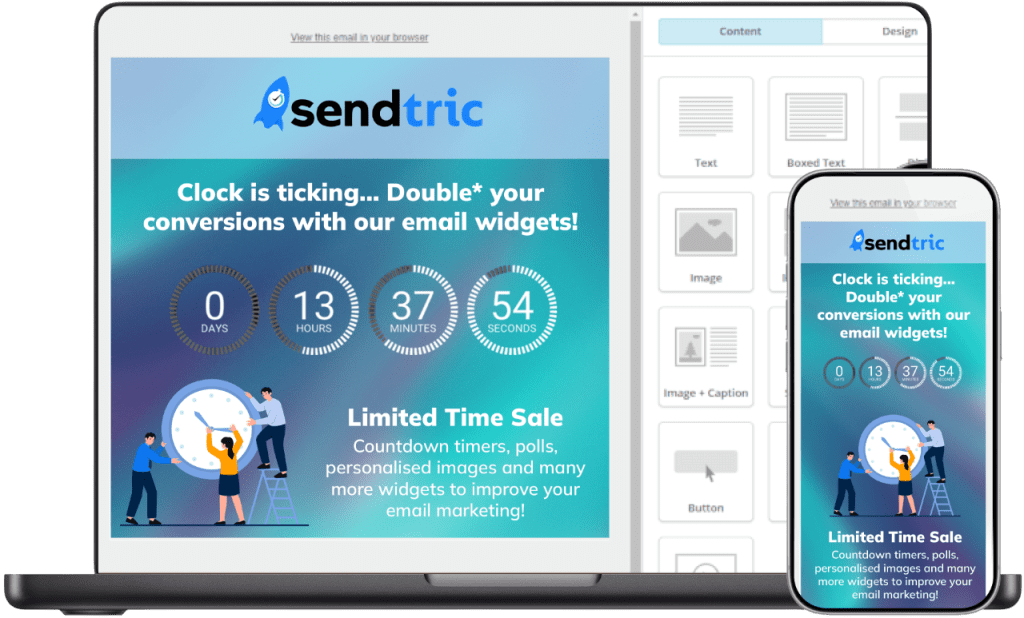
Sendtric gives you a suite of tools that hook readers and keep them scrolling to your CTA, without any complex coding or development resources.
Looking to maximise urgency in your emails? Get countdown timers that display the exact remaining time for your offers. Want to personalize emails to each recipient? Sendtric lets you generate personalized images that dynamically change based on your subscriber data.
Generate interactive polls or add weather widgets that pull real-time conditions for localized campaigns, giving users full experiences that match their location or current needs.
Sendtric’s widgets are designed to work seamlessly on all major email clients, across desktop, mobile, or tablet, integrating effortlessly with your email campaign platform. You can even integrate Sendtric with your AI agent of choice. And the best part? It’s all included in every pricing tier – even our free plan!

Create your free email countdown timer
- Fill out the form with your desired countdown options
- Click Generate
- Confirm your email address
- Copy and paste the provided HTML code into your email template
- Enjoy your free email countdown timer from Sendtric with 10,000 free monthly views.*
No watermark – Up to 10,000 monthly views* on our FREE Plan
*If you exceed 10,000 free views in a month, a watermark will appear until the limit resets. Upgrade to remove it at any time. Paid plans never show a watermark, even if the limit is exceeded.
Your timer is ready!
Check your email to get access to the timer's code so you can integrate it in your email campaign and make edits if you wish.
Frequently Asked Questions
Is AI safe to use for email copywriting?
Only with heavy human editing, and even then it’s best to be original. By all means, get inspiration – but never send AI-generated copy without a human reviewing for tone, accuracy, and brand alignment.
Will using AI get my emails marked as spam?
Potentially, yes. Spam filters are increasingly trained to detect AI-generated patterns, so making your whole workflow AI-based is probably going to trigger spam filters. Always test before sending at scale.
What is “AI slop” and why does it matter?
AI slop is mass-generated content produced with low effort, leading to low quality. It matters because audiences are actively rejecting it, leading to lower open rates, higher unsubscribe rates, and brand damage.
How do I personalize emails with AI?
Personalize based on observed behavior (past purchases, browse history, abandoned carts) and stated preferences (survey responses, preferences settings). Avoid personalizing based on sensitive data, like location beyond the city level, or browsing history unrelated to your product.
What is an AI agent in email marketing?
An AI agent is an automated process that continuously monitors data sources (internal and external) and triggers email sends based on specific intent signals. Unlike a simple automation rule, an agent can adapt to new signals over time.
How many emails should I send using predictive AI?
Fewer, not more. Predictive AI helps you send the right email at the right time, which often means sending fewer total emails but achieving higher engagement. Focus on intent signals, not volume.
Sources
[1] https://www.numerator.com/resources/blog/ai-generational-trends/
[2] https://www.poddigital.co.uk/digital-marketing-news/the-complete-2026-guide-to-effective-compliant-and-ai-ready-email-marketing/
[3] https://www.braze.com/resources/articles/the-ultimate-guide-to-creating-a-high-impact-email-marketing-strategy
[4] https://www.litmus.com/blog/guide-to-ai-in-email-marketing