


Key Takeaways
- Full 2025 data shows that the average cart abandonment rate across ecommerce sits at 76.8% [1], but revenue left in abandoned carts is not necessarily lost
- Up to 20% of abandonments can be recovered and converted to sales [4]
- Recovery emails are the top channel [3], boasting impressive metrics (average open rates of 40% to 45%). Timing is critical, with the first email ideally sent within 4 hours of abandonment
- The top reason for abandonment is unexpected extra costs at checkout (55%) [1], followed by forced account creation and long checkout processes. Tackling these specific friction points directly prevents future abandonment and improves recovery success
- Mobile users abandon carts at a significantly higher rate (over 78%) [2] than desktop users. A fast, simple, trustworthy mobile checkout experience is essential
- Recovery is not just about sending emails. A multichannel approach using SMS, retargeting, and on-site optimizations (like guest checkout and social proof) will help recapture lost sales [5]
How well do your abandoned cart recovery strategies shape up?
Globally, abandoned cart rates are at 76.8%. But why are they so high, and how can ecommerce retailers win customers back? Let’s look at the latest cart abandonment statistics, study the factors that influence it, and teach you how to recover more abandoned carts.
Cart Abandonment and Recovery Rates in 2026
Wait… what do “cart abandonment rate” and “recovery rate” even mean?
Basically, cart abandonment rate is the percentage of online shoppers who add items to their cart, but leave the website without completing the purchase.
Abandoned cart recovery rate is the percentage of online shoppers who come back and make a purchase from their cart.
To understand how well you can recover abandoned carts, you need to know the scale. The latest data from Mastercard Dynamic Yield (with data from 200 million unique monthly users throughout 2025) places the average online shopping cart abandonment rate at 76.8% [1].
This means for every 10 customers who add an item to their basket, only 2 will complete the purchase on their first visit.
But the Baymard Institute’s ten years of research indicates that a significant portion of this lost revenue is reclaimable. In fact, focusing solely on solvable checkout usability issues, the average large ecommerce site can achieve a 35.26% increase in conversion rate [2].
When applied to the broader market, this translates to a staggering $260 billion in recoverable sales [2].
Industries with the Highest Cart Abandonment Rates
|
Industry |
Cart Abandonment Rate |
|
Overall Average |
76.8% |
|
Beauty & Personal Care |
81.71 |
|
Luxury & Jewelry |
79.84 |
|
Fashion & Accessories |
77.80 |
|
Retail |
76.22 |
|
Home & Furniture |
72.70 |
|
Food & Beverage |
71.98 |
|
Consumer Goods |
61.81 |
|
Pet Care |
53.06 |
Data from Mastercard Dynamic Yield’s 2025 study [1]
Why Do Shoppers Abandon Their Carts? (And How to Fix It)
Understanding why users leave their cart without buying is the first step to crafting an effective strategy for recovery.
The truth is, the majority of cart abandonments are simply window shopping – customers who aren’t ready to buy, or are just putting together a “wishlist” if the website doesn’t offer that functionality.
But for everyone else, cart abandonments are caused by specific, addressable pain points.
Here are the main offenders – and how to fix them.
The following data comes from Dynamic Yield’s 2025 ecommerce benchmarks [1] and ten years of research from the Baymard Institute [2].
1. Unexpected Extra Costs: 55% of abandonments
This is the single biggest dealbreaker – more than half of all shoppers will leave if they encounter surprise shipping fees, taxes, or handling charges at the final stage.
The Fix: Add a shipping calculator on the cart page.
Be transparent about all potential costs as early as possible in the shopping journey. You can offer a free shipping threshold, which can increase average order value while eliminating a major friction point.
2. Forced Account Creation: 25% of abandonments
Having to sign up before a first purchase is a significant barrier. It creates friction and raises privacy concerns for new customers.
The Fix: Always enable guest checkout.
You can incentivize account creation after the purchase is complete, by offering benefits like order tracking, faster future checkouts, or future discounts.
3. Security Concerns and Lack of Trust: 17% of abandonments
Rampant hacks, leaks, and data breaches have left shoppers feeling cautious. A checkout page with no visual security cues will crush confidence instantly.
The Fix: Saturate your checkout with trust signals.
Display SSL security badges, show trusted payment method logos (PayPal, Visa), and guarantees (money-back, free returns). Forms with trust badges can see a 42% increase in conversion.
4. Lengthy or Complicated Checkout Process: 21% of abandonments
A checkout with too many steps or form fields is a conversion killer, especially on mobile.
The Fix: Streamline relentlessly.
Reduce form fields to the bare minimum (Baymard recommends 12-14 total form elements). Implement auto-fill features and offer one-click checkout options like Shop Pay or PayPal, which can convert up to 50% better than standard guest checkouts.
5. Slow Delivery Estimates: 21% of abandonments
Modern shoppers expect speed and clarity. Vague or slow delivery timelines create uncertainty.
The Fix: Provide clear, realistic delivery estimates early.
If possible, offer expedited shipping options. Transparency builds trust and manages expectations.
Developing a Recovery Strategy
Abandoned Cart Email Sequences
Prevention (using the fixes above) is crucial – but having a strategic recovery system is the only way you can directly recapture lost revenue. Automated abandoned cart email sequences remain one of the highest-ROI activities in ecommerce.
- Up to 20% of all abandonments can be recovered and converted to sales [4]
- Up to 45% of abandoned cart emails are opened [3]
- 21% of opened emails receive click-throughs [3]
- 50% of the users who clicked purchased [3]
Data sourced from Moosend and Convertcart
How to Create a High Converting 3-Email Sequence
With an up to 45% open rate [3], abandoned cart emails are the closest thing to a silver bullet solution you could ask for. But remember the golden rule: be helpful, not spammy. Gently guide users back to the products they loved on your website, and incentivize the purchase when it makes business sense.
Here’s a proven timeline and structure for your abandoned cart emails.
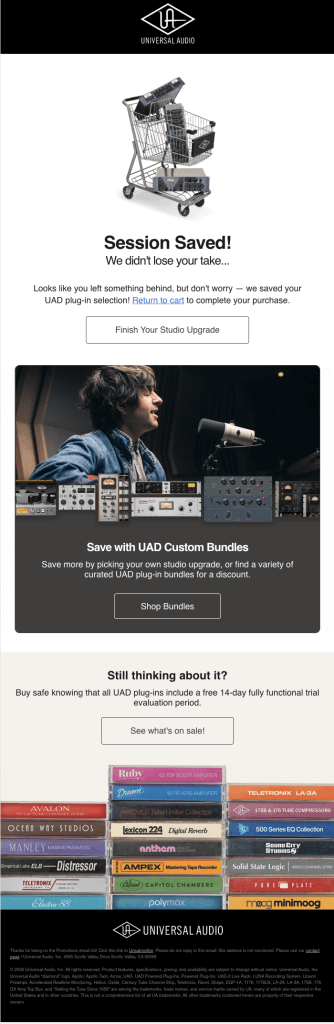
Email 1: A Gentle Reminder (Send 2-4 hours after abandonment)
Goal: Reignite intent. Assume the customer got distracted.
Content: Show a clear image of the abandoned item(s), reiterate key benefits, and include a prominent “Complete Your Purchase” button. No discount needed here – just remind the user that they’ve got something to do today!
Email 2: Added Incentive (Send 24 hours later)
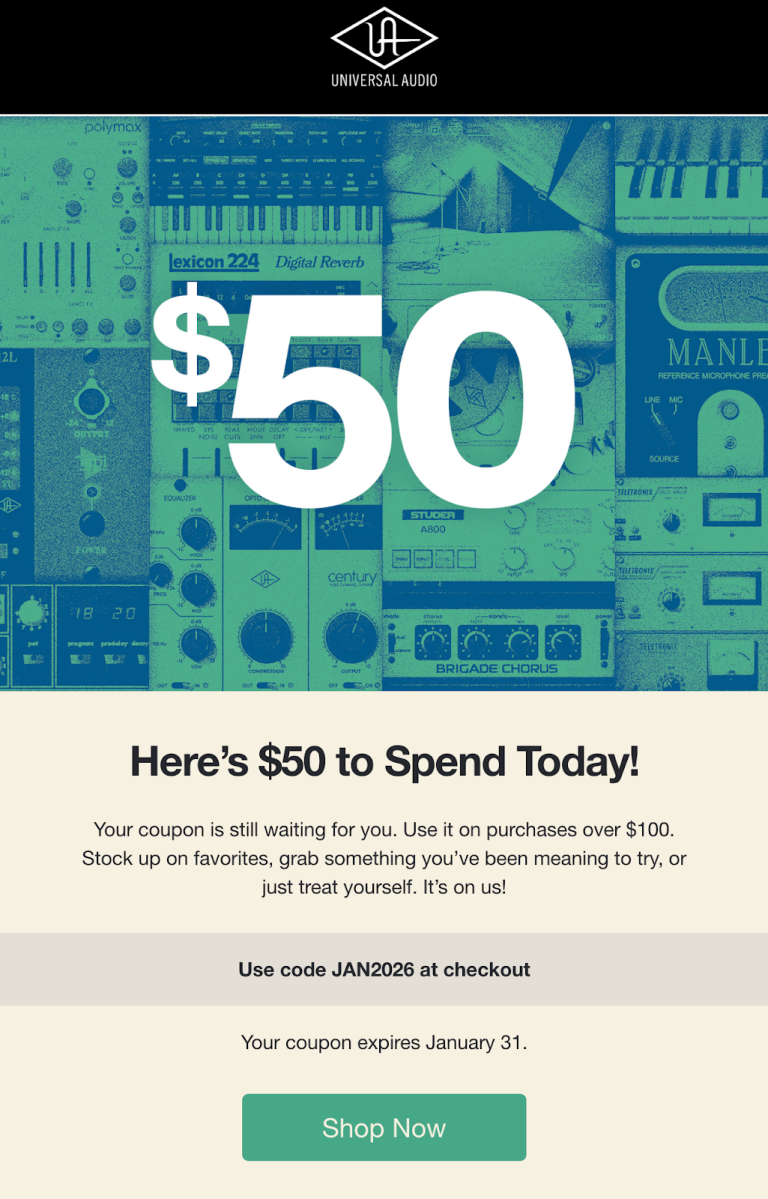
Goal: Overcome hesitation. Add a nudge to tip them over the edge.
Content: Gently highlight potential pain points (“Worried about fit? We offer free returns” or “14-day trial period included!”). This is where a strategic incentive can work, like free shipping or a discount code. Create urgency by noting low stock, or give their incentive a countdown for expiry.
Email 3: Urgency (Send 72 hours later)
Goal: A last-chance appeal using scarcity.
Content: Use a stronger subject line (“Your cart is expiring soon!”). Visually emphasize that the items are reserved for them but won’t last forever. Incorporating a dynamic countdown timer in the email can heighten urgency – it psychologically screams “scarcity!”.

Multichannel Recovery Tactics
If you really want to amp up your abandoned cart recovery rates in 2026, you need to think beyond email – and into SMS and retargeting ads.
SMS text message reminders have open rates often exceeding 90%. SMS is a powerful tool for high value abandoned carts. Keep messages concise, with a direct link to the cart.
Running retargeting campaigns? Displaying ads for abandoned products as a user browses other websites can reduce cart abandonment by 6.5% [5] and has the potential to increase overall sales by 20% [4]. Personalized ads use browsing cookies to retarget users with highly relevant promotions for products they have already displayed an interest in – like those in their cart.
Retargeting ads can give personalized offers that match the customer and your goals. So if your main objective is to capture a new customer to give them an incredible experience and get repeat custom, your initial offers can be far more extreme. Think of it as a “loss leader”, to win customers over and prove you’re the place to go for all their needs.
But Optimize Your Checkout Experience FIRST!
All recovery tactics will underperform if your core checkout experience isn’t good enough. This is especially true for mobile, where abandonment rates are above 78%.
So, design a mobile-first checkout experience. The entire checkout flow has to be thumb-friendly, with large buttons (over 44px), simplified forms (with autofill enabled) and integrated mobile wallets (Apple Pay, Google Pay, PayPal).
Offer buy now, pay later (BNPL) options like Klarna or Clearpay. This directly addresses cost concerns and can improve checkout conversion by 78% while increasing average order value.
And make it all work fast. A slow or buggy checkout is a conversion killer, so optimize page load times across all devices.
Your Action Plan for Abandoned Cart Recovery
Okay, so we’ve got some tactics – now, let’s put it all into an actionable strategy that will move the needle and win more sales. Take the checklist below, and create your own abandoned cart recovery strategy for 2026.
Immediate Actions (To Do This Week)
1. Check Out Your Checkout
Use your checkout as a customer and look for friction points. Is guest checkout enabled? Are all costs displayed upfront? Is the user experience at least as good as your competitors’? Add autofill features, improve digital wallet integrations, and think about buy now, pay later options.
2. Activate Basic Email Recovery
Set up a simple 3-email sequence in your email marketing platform – see our example above. Use email widgets, like email countdown timers, to push urgency and nudge users towards their purchase.
3. Add Trust Badges
Get SSL and payment logos, and make sure they’re visible throughout your cart and checkout pages. Accreditations, awards, social proof and reviews from trusted platforms are all a big help, too!
Short-Term Optimizations (Next 2-4 Weeks)
- Look up Exit-Intent Pop-ups [5], and install them on your cart page
- Refine your email sequence, with personalization and dynamic product images
- Analyze your mobile checkout flow for any clear friction points
Long-term (Ongoing)
The biggest ongoing strategy – and the one that will define your long-term gains – is A/B testing.
Test everything. Subject lines, email timing, incentive offers, checkout button colors, images… everything. You’ll discover what your customers really value this way, and optimize your process to a highly granular level.
Other ongoing strategies to consider:
- Explore SMS Recovery for your highest-value customer segment
- Design and roll out a loyalty program to turn one-time recoveries into repeat customers
- Regularly review analytics to identify new abandonment trends or page-specific issues
Recovering abandoned carts is a fundamental part of running a high-performing ecommerce operation. By understanding the customer’s reasons for leaving, deploying a multichannel recovery system, and relentlessly optimizing the checkout experience – you can transform your biggest weakness into a consistent revenue stream.
Are Your Current Abandoned Cart Recovery Rates Up to Standard for 2026?
Let Sendtric turn your abandoned carts into your most valuable sales channel – with email countdown timers that create urgency, scarcity, and grab your customers’ attention.
Add Countdown Timers to Your Ecommerce Emails
A countdown timer is a dynamic email widget that displays the remaining time before an offer, sale, or event expires. Countdown timers improve conversions by taking advantage of three proven human behavioral mechanisms:
Countdown Timers in Ecommerce Emails
A countdown timer is a dynamic email widget that displays the remaining time before an offer, sale, or event expires.
Countdown timers improve conversions by taking advantage of three proven human behavioral mechanisms:
Urgency – Reduces procrastination.
Scarcity – Reinforces limited availability.
Attention anchoring – Draws focus immediately after emails are opened.
Create your free email countdown timer
- Fill out the form with your desired countdown options
- Click Generate
- Confirm your email address
- Copy and paste the provided HTML code into your email template
- Enjoy your free email countdown timer from Sendtric with 10,000 free monthly views.*
No watermark – Up to 10,000 monthly views* on our FREE Plan
*If you exceed 10,000 free views in a month, a watermark will appear until the limit resets. Upgrade to remove it at any time. Paid plans never show a watermark, even if the limit is exceeded.
Your timer is ready!
Check your email to get access to the timer's code so you can integrate it in your email campaign and make edits if you wish.
Frequently Asked Questions
What does abandoned cart mean?
An abandoned cart is when a user adds a product to the cart on an ecommerce website, but doesn’t buy it.
What is an acceptable abandoned cart rate?
The global average (as of January 2026) is 76.8%. Different industries have different rates: in beauty and personal care, the rate is highest at 81.71%.
What is an acceptable abandoned cart recovery rate?
10% to 20%. This means that for every 100 customers who abandon their carts, up to 20 of them will return to purchase from you.
How to deal with abandoned carts?
Personalized emails are the most effective tactic, with open rates of up to 45%, CTR of 21% and an astonishing 50% conversion rate for users who click through. On-site pop-ups, SMS reminders, and retargeting ads are other highly effective strategies – but checkout experience must be optimized first.
Why do people abandon carts?
55% of users abandon their carts due to hidden extra costs: shipping, taxes, tariffs, and other fees.
How can I make abandoned cart emails that convert?
Make emails personal – not just using customers’ names, but including the items in their carts, with dynamic images and offers based on their history. Escalate urgency with an automated email timeline – and add attention-grabbing countdown timers to your ecommerce emails to reinforce this.
Sources
[1] https://marketing.dynamicyield.com/benchmarks/cart-abandonment-rate/
[2] https://baymard.com/lists/cart-abandonment-rate
[3] https://moosend.com/blog/cart-abandonment-stats/#abandoned-cart-emails
[4] https://www.convertcart.com/blog/cart-abandonment-rate-statistics
[5] https://www.dynamicyield.com/lesson/6-exit-intent-tactics/